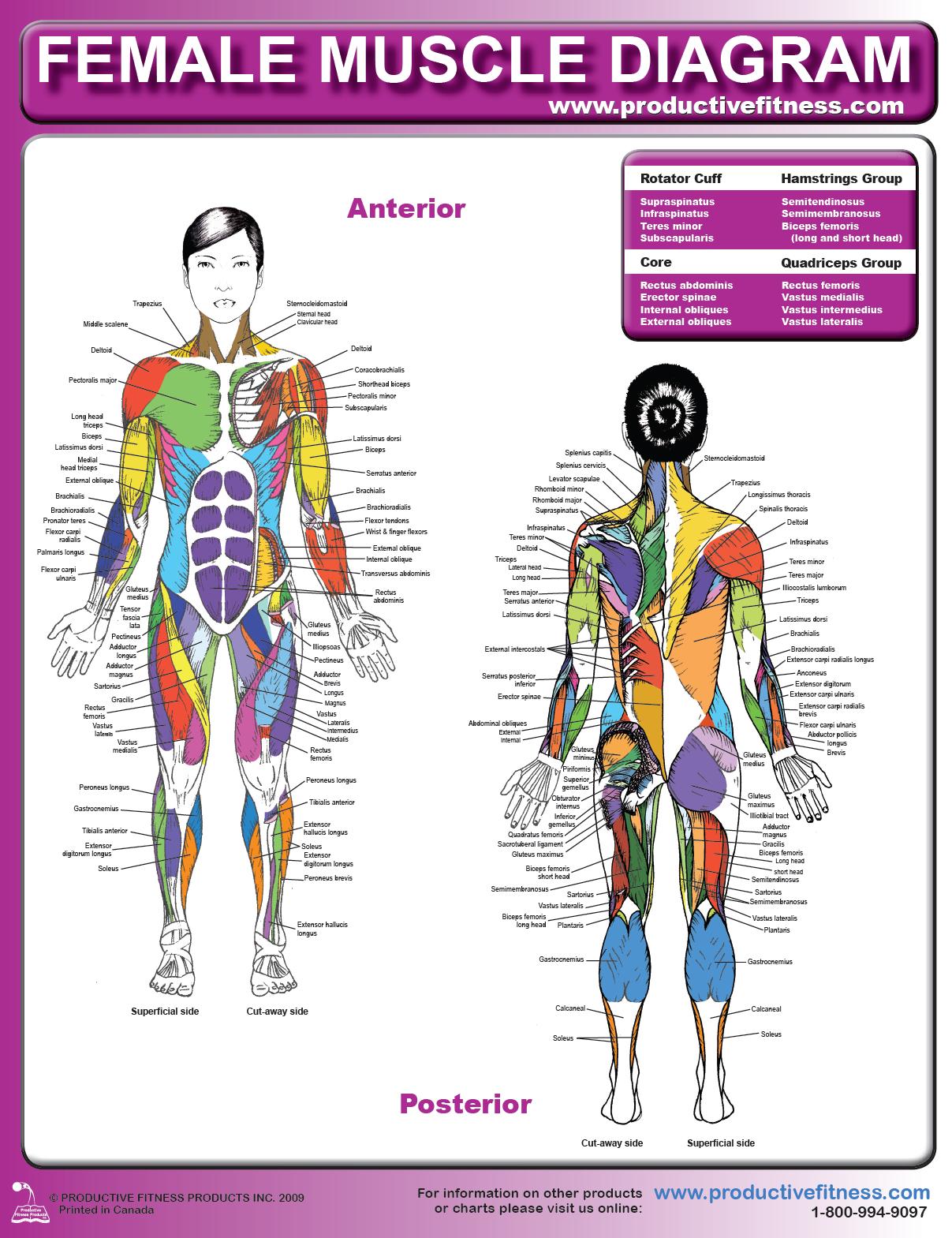
Female muscle diagram

Female muscle diagram
DEFINITIONS
Abductor muscle (ab-duhk-ter) A muscle which draws a limb away from the median plane of the body.
Abs or abdominals (ab-dom-uh-nl) The abdominal muscles are a group of 6 muscles that extend from various places on the ribs to various places on the pelvis. They provide movement and support to the trunk, often called the core. They also assist in the breathing process.
Adductor muscle (uh-duhk-ter) A muscle which brings a part of the anatomy closer to the median plane of the body.
Aerobic (ai-roh-bik) Requiring the presence of air or oxygen.
Bis or biceps (bahy-seps) A flexor muscle located in the front of the upper arm and assisting in bending the arm.
Core (kohr) – see abdominals – The six abdominal muscles are: transverse abdominal, two internal obliques, two external obliques and the rectus abdominis.
Cuffs or Rotators Cuffs (roh-ta-tor) A bandlike structure encircling and supporting the shoulder joint, formed by four muscles attached and merging with the joint capsule.
Glutes or gluteous maximus (gloo-te-us mak-suh-muhs) The broad, thick, outermost muscle of the buttocks, involved in the rotation and extension of the thigh. The largest muscle in the body.
Hams or hamstrings (ham-strings) Refers to one of the three posterior thigh muscles, or to the tendons that make up the borders of the space behind the knee.
Karvonen Method – The method of taking heartrates that factors in the resting heart rate to calculate a target heart rate using a range of 50-85%.
Lats or latissimus dorsi (luh-tis-uh-muhs dawr-sahy) A broad, flat muscle on each side of the midback, the action of which draws the arm backwards and downward and rotates the front of the arm toward the body.
Muscle (muhs-uhl) – A tissue composed of cells or fibers, the contraction of which produces movement in the body
Obliques (oh-bleek) The external oblique muscles of the abdomen functions to pull the chest downwards and compress the abdominal cavity. When the internal oblique contracts it compresses the organs of the abdomen, pushing them up into the diaphragm. Its contraction also rotates and side-bends the trunk by pulling the rib cage and midline towards the hip and lower back.
Pecs or pectorals (pek-ter-uhl) A thick, fan-shaped muscle, situated at the chest (anterior) of the body. It makes up the bulk of the chest muscles in the male and lies under the breast in the female.
Quads or quadriceps (kwod-ruh-seps) A large muscle group that includes the four prevailing muscles in the front of the thigh, the action of which extends the leg or bends the hip joint.
Traps or trapezius (truh-pee-zee-uhs) A broad, flat muscle on each side of the upper and back part of the neck, shoulders and back, the action of which raises, or rotates, or draws back the shoulders, and pulls the head backwards or to one side.
Tris or triceps (trahy-seps) A muscle having three heads or points of origin, especially the muscle on the back of the arm, the action of which straightens the elbow.
Vertifirm™ (ver-ti-firm) – “vertical firmness” – Standing up floor exercises allowing you the benefit of working more than one muscle group at a time by adding upper body resistance training.
I’ve posted below the great story Mel sent to Head Office earlier this year. It’s a perfect opener for your posting place in Jacki’s Blog.
Leave a reply at the bottom of this page to tell us your story, or anything you want to share with other Jacki’s dancers. Don’t forget to tell us about your first class at “When Did You Join Jacki’s?”
Diana
——————————————
I’m happy to say that I returned to Jacki’s Aerobic Dancing after an absence of 15 years; previously attending classes at Epping. I stopped dancing when I became newly married.
What inspired my return to Jacki’s Aerobic Dancing after such a long hiatus was seeing the movie, ‘Burlesque’. After viewing the cheesy chick flick, I realised that I loved to dance and had been away from doing something creative and active for too long. Who could have guessed that Christina Aguilera would be so inspiring!
I have since joined the Saturday morning group at East Ryde and have thoroughly enjoyed my reacquantaince with, not only the way dance and movement makes my body feel, but also some of the original attendees from the previous Epping class a very pleasant surprise!
After an absence of over a decade, it’s true that the songs are more Justin Timberlake and Taio Cruz than Rod Stewart or Bryan Adams and the instructors wear microphones to ensure that they are clearly amplified throughout the dances – all very modern!
However, what hasn’t changed is the buzz I get from mastering a new routine while using dance movement to sculpt and tone my body. I’ve thoroughly enjoyed my return to Jacki’s Aerobic Dancing and I’m sure that it will continue for many years to come.
Mel Krenmayr
April 2011
 Heart Rates how and why
Taking student heart rates (heart beats per minute) throughout class has always been an integral and a serious part of Jacki’s Aerobic Dancing. Tracking your heart rate
Most students find their pulse by placing the first two fingers of either hand on one of the two carotid arteries, located in the neck straight down from each eye. Alternatively, you may place your fingers on the pulse at your wrist, or your hand over your heart. Do not use your thumb, which has a faint pulse of its own.
Your instructor will tell you how to determine your resting heart rate at home and will use it and your predicted maximum heart rate (220 minus your age) to help you determine your working heart rate (WHR) zone.
In every class, you will take a
The pre-class heart rate (6 seconds)
This count is taken during pre-class calf stretches. It establishes a base line for the hour’s activity. When the instructor calls “heart rates”, locate your pulse and start counting when she says “Start”. When she says “Stop” after six seconds, add a zero. Thus a count of 8 for 6 seconds becomes 80 for 60 seconds (one minute). Call out the 80 to the instructor when she asks.
The working heart rate (6 seconds)
Following the Body Sculpting Medley (during which the instructor faces the students), the Booster opens the aerobic portion of class. This first aerobic dance is called the Booster because is boosts you into your working heart rate zone. Your heart rate must stay in your WHR zone until the Cooldown for your workout to be of aerobic benefit that is, have a “training effect” on your cardiovascular system.
At the end of every aerobic dance, the instructor says, “Circle up for heart rates” and the students move immediately to walk quickly in an anti-clockwise circle and locate their pulse.
The instructor walks inside the circle but in the opposite direction – clockwise – as she counts six seconds. As soon as she says “Stop”, she continues walking quickly, listening for heart rates as she looks each student in the face.
If you have to slow your pace while counting, you should quicken it again as soon as the instructor says “Stop”. If you cannot walk and count at the same time, you should step outside the moving circle while counting and rejoin it as soon as the instructor says “Stop”.
You should continue to walk quickly anti-clockwise and only leave the circle after you have given the instructor your heart rate. The dance is finished now not when the music stops!
Now is the time to pick up your water bottle (not before, please), have a drink, and keep your legs moving until the next dance begins.
The recovery heart rate (15 seconds)
The recovery heart rate is taken during calf stretches following the Cooldown dance, approximately five minutes after the end of the last aerobic dance. It is taken for 15 seconds, and this time you do not add a zero. If your count is over 30 (120 beats per minute) you may be asked to remain after class for a second counting to ensure that your heart rate has returned to its normal level.
Some frequently asked questions:
Q. What is a “‘good” heart rate? This is unique to every student and depends on one’s age, resting heart rate and level of activity at the time of measurement. As you become more aerobically fit and your cardiovascular system becomes more efficient, your resting heart rate may lower, though this is not always the case.
Q. Why do we take heart rates after every aerobic dance? The answer to this is in the first paragraph of this article.
Q. Why do we have to walk in a circle? Because, with the instructor moving in the opposite direction, this is the quickest and most efficient way to accomplish the task, minimizing the “down” time between dances. Our goal is sustained movement in our working heart rate zone for the duration of the aerobic segment, that is, from the Booster to the Cooldown.
Q. Why do we have to walk quickly and immediately the music stops? So your heart rate will still be the same as when you were dancing (working) that’s what we want to measure. It drops off quickly when you slow your pace or stop moving. And again, because we want to minimize the time between dances.
Q. Why do we have to keep our legs moving between dances? As above to keep in our working heart rate zone and also to keep our blood circulating and not “pooling” in our feet.
Jacki Sorensen describes Aerobic Dancing as Serious fun. We’re serious about having fun, but also serious about the safety and effectiveness of everything we do. Monitoring heart rates is an important part of caring for our students, and showing them how to care for themselves.

In the floorwork segment of class, we work our abdominal muscles by curling up from a lying position in a variety of ways. Important points are:
| • Correct execution matters in these routines, so please watch your instructor and imitate her form. If she is facing your side of the room, you will need to turn your mat 90 degrees or more to see her. If this upsets your sense of left and right, choose a position on the other side of the room. (The instructor’s verbal cues always refer to the students’ left and right.)
• Support your head with your hands during curls but do not pull on your neck. We recommend using your fingertips to make a cage around your ears. Clasping your hands behind your head or neck is more likely to result in a sore neck. • During curls (and some other moves when cued by your instructor), keep your lower back pressed to the floor. This protects against back strain and develops your lower abs. • Keep your eyes on the ceiling during curls, with a space the size of an orange under your chin. This ensures that your neck stays in line with your spine and that your abdominals, not your arms, lift your head and shoulders. |
• Rest when you need to. Even if you can manage only one or two curls at first, you will gradually be able to do more as your abdominal muscles strengthen.
• Keep your head and shoulders lifted during routines that involve leg extensions like take-a-walk and leg pulleys. If you need a rest and want to lower your head, also stop moving your legs in order to avoid back strain. • If curls are combined with leg extensions and you want less challenge, stop curling but keep your legs going with head and shoulders lifted. Alternatively, you may stop the leg movements and just do the curls. • If you want a break during clam curls (curl combined with hip lift) you may stop either the curl or the hip lift, or both. In the clam curls, the legs are not extended horizontally so the potential for back strain is avoided. |
If all the above seems too much to remember, don’t worry! Your instructor will guide you, so just heed her cues and copy her moves.
When did you first experience a Jacki’s Aerobic Dancing class?
Do you remember the name of your first session? Click here to see a list of all of them.
Who was your first instructor?
Why have you stayed with Jacki’s program?
Tell us your story.
I’ll go first to get the ball rolling …
In 1981 I read an article in the Sunday Telegraph about Jacki Sorensen and her
Aerobic Dancing program which had recently started up in Sydney.
I had been a dance student for ten years (ballet, jazz and tap) through my childhood
and adolescence, and although I’d attended traditional “aerobics” classes for fitness,
I had really missed the “dance” in my life.
I attended a class on the top floor of the old RSL building in George Street in the city.
The instructor was Wendi Eston (ex Australian ballet), and there were only six of us in
the class. I loved it and was thrilled to discover that there was a class running near where I lived at Drummoyne.
I joined up there where Holly Muggleston was the instructor and never
missed a class. Subsequently Holly suggested that I might want to consider instructing.
I did and my first class was in Balmain in September 1983 with four students!
That session was called Harmony.
Diana Royds
_______________________________________________________________
Yes and no.
In the floorwork and the VertifirmTM segment immediately following it, proper execution of moves is important. This part of the class is designed to tone and strengthen specific muscles, but the intended body benefit is diminished or even lost if a move is done incorrectly. This is why your instructor will sometimes demonstrate a move’s correct form before or after class, and why during routines she cues reminders to position your limbs a certain way, etc. Continue reading In class, does form matter?
Walk into any gym and you’ll probably see the weights room filled with men doing bench presses, while the stretch classes are 99% female. This needs to be reversed, say Greg Stark, from Better Being Personal Training.
Fitness isn’t instantaneous, but you need to make a start. The biggest problem is finding something you can commit to with the discipline that gets results. Congratulations! You’ve already done that. By joining Jacki’s Aerobic Dancing, you’ve found, like thousands of others, that coming to class is a joy because Jacki’s program is FUN. That’s why some of you have been coming continuously since classes opened in Sydney in 1981. Continue reading How aerobic dancing benefits your fitness now!