
Sidelifts Low, Cuffs Out

Stretching offers many benefits: mobility, injury prevention and stress relief, to name a few. But when exercising, is it better to stretch before or after? The answer is: before and after.
Before exercise you need to warm up and dynamic stretching can be combined as part of the warm-up. The goal is to get the blood flowing and raise your body temperature a little. It’s important to have your muscles, ligaments and joints experience the functional range of motion required of your sport during the warm-up. Movements such as arm circles, torso twists and hip rotations are examples of dynamic stretches.
After your workout, it’s time for static stretching. This is the time to relax, wind down and improve flexibility. Hold each stretch for at least 30 seconds and stretch consistently to see results. Focus on breathing during the stretch, using each exhalation to go a little further.




By Barbara Quinn McClatchy – Tribune News Service
Belief that something is true without evidence — such as betting on your team to win the Super Bowl — is a presumption.
Belief that persists despite evidence to the contrary — such as refusing to believe your team lost — is a myth.
Understanding supported by good evidence — such as realizing the trophy resides with another team — is a fact.
How do these definitions apply to our long-held beliefs about weight loss? A group of researchers looked at the evidence in a recent article in the New England Journal of Medicine. Here are a few beliefs they determined to be myth, presumption, or fact (along with a few unsolicited comments):
Small changes in how we eat or exercise over a long period of time will cause us to lose large amounts of weight. It’s a myth. Studies show that small changes result in small weight losses and large changes result in larger weight losses. Duh.
Eating breakfast on a regular basis helps guard us from being overweight. It’s a presumption, based on a few small studies done several years ago, say researchers.
Eating more fruits and vegetables will cause us to lose weight or gain less weight. This is also a presumption. Health benefits abound from eating fruits and vegetables. Yet there is no evidence that we will automatically lose weight if we eat more of these foods.
Eating breakfast or adding more vegetables to our diet does not help us lose weight unless if we also eat fewer calories. This is a fact. We can lose weight with any diet strategy if our calorie intake is low enough.
Setting realistic goals for weight loss is important so we won’t become frustrated. This is a myth, say these researchers. Really? They explain that more ambitious goals are sometimes associated with more weight loss. To which I respectively argue that “ambitious” goals can also be “realistic” goals.
Losing large amounts of weight quickly is not as good for us in the long term as slow, gradual weight loss. This is a myth, believe it or not. According to controlled clinical trials, people who lost weight quickly at the beginning of a weight loss regimen were as successful after one year as those who had lost it slowly from the beginning.
Our genes do not determine our destiny to be overweight. This is a fact — and a challenge, nutrition experts say. Think of it this way, someone once explained: What we inherit from our parents “loads the gun.” But what we choose to do — or not do — each day “pulls the trigger.”
Physical activity improves our health, regardless of what we weigh. This is a fact.
High protein diets now dominate the weight-loss scene. Many of you may have tried one of the many popular diets such as the Zone and Atkins diets.
Nutritionists are constantly being asked, “Do these diets work?” and “How much protein should I be eating?” The truth is, protein has many more functions than simply assisting with weight loss. We should be focusing on protein’s health benefits instead of what it can do for our waistlines.
Apart from being required to build muscle, protein is also the basis of our tendons, ligaments, collagen, hair and skin. Dietary protein sources are necessary for healthy hormone production, correct fluid balance and the transportation of vitamins, minerals and oxygen throughout the body. Protein is also essential for antibody production and a healthy immune system.
Including protein in meals promotes the feeling of fullness, satisfies hunger and reduces the need for extra, unnecessary kilojoules. And foods that are naturally high in protein also have a low glycaemic index which means they have little effect on blood-glucose levels.
But protein-only diets are unbalanced and lacking in vital vitamins, minerals and nutrients.
The recommended intake of protein is between 0.7 to 1.7 grams per kilogram of body weight depending on activity levels and whether or not you are pregnant.
Greats sources of protein include meat, poultry, fish, dairy, nuts, seeds, legumes and beans and good sources include grains such as rice, quinoa and multigrain bread.
Protein sources:
100g chicken or meat = 22g-25g
Half a cup soybeans = 14g
200g yogurt or 40g cheese = 10g
1 cup dairy or soy milk = 8.5g
Half a cup legumes = 8g
1 cup cooked rice = 4g
Teresa Boyce, Nutritionist, in Body + Soul 20/05/12

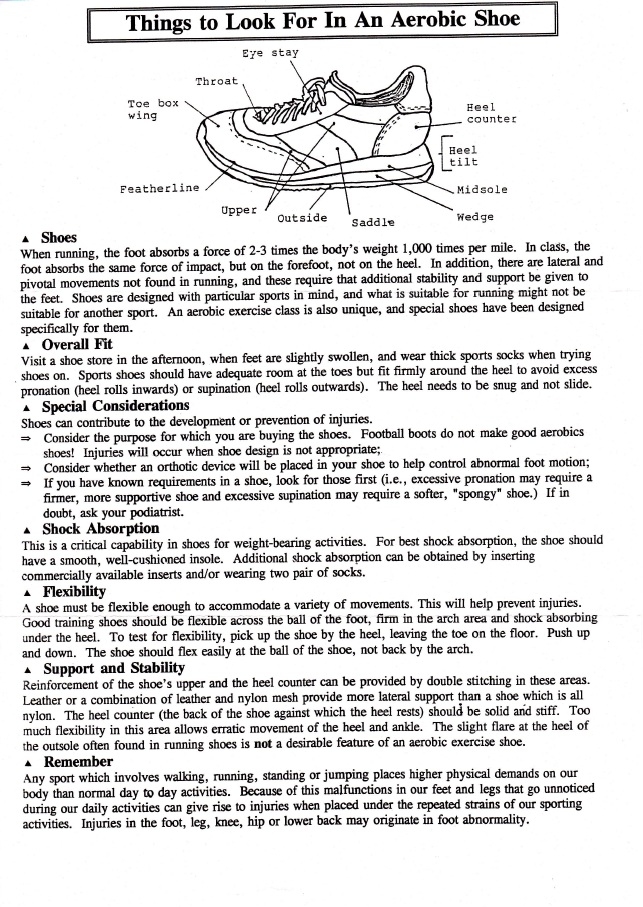
Students often ask about the shoes that instructors wear, and what we would recommend for Jacki’s program.
Please read Things to look for in an aerobic shoe at the end of this article.
For myself, I’ve worn Ryka shoes for the past 15+ years. Their Studio Flex model (http://www.ryka.com.au/products/studio-flex) is designed for indoor aerobics and is very light-weight, so is perfectly suited to Jacki’s Dance classes. Another big plus for me is that these shoes are available in black, and since I generally wear black pants I can achieve a “longer” look. Pairing dark long pants with white shoes visually cuts you off at the ankles and makes the wearer appear shorter. At 5’2″ I don’t need any help to look short!
Ryka shoes (from the USA) are made specifically for women’s feet and feature a narrow heel with a wider front. Ryka change their styles from year to year, so I’ve worn plenty of different models, but all work well for our classes. The Athlete’s Foot carry a limited range of Ryka shoes but they are expensive.
Many students have mentioned that when they are shopping for a new pair of shoes for aerobic dancing classes, the shop assistants always recommend a cross trainer. This occurs, I think, because the retailers do not know what aerobic dancing exercise is, and they think that a cross trainer will do the job simply because it is a general all purpose type of exercise shoe. However, because the design of the cross trainer is non-specific (for any particular sport or activity), this means that functionality may be compromised in other areas.
I would recommend a shoe designed for netball, squash or tennis, since the moves in these sports are quite similar to those used in aerobic dancing classes — swivelling and lateral movements in amongst the jogging and lunging actions of the dance routines.
The good news is that this style of shoe is readily available in many brands and price ranges. And I’ve even seen them in black. 🙂
Then climb ‘em again!
Stair-climbing is a remarkable form of exercise. It’s aerobic because it increases your heart rate and works your lungs, it conditions and strengthens your lower body, and it prevents osteoporosis. On every step, your legs bear the load of your body weight. The vigorous action of your leg muscles pulling against your leg bones increases bone density.
‘Counting steps instead of miles can boost your walking workout and save you time,’ says www.prevention.com. ‘Researchers in England and Northern Ireland asked 12 sedentary women to climb a 200-step staircase, progressing from once a day to six times a day (they were allowed to take the elevator down.) Each ascent took about 2 minutes, so by the end of the study, the women were exercising only 12 minutes a day. In less than two months, they saw a boost in their fitness level, along with improvements in their cholesterol level that were enough to cut their risk of cardiovascular disease by 33 percent.’
If you live in a two-storey house you will have a set of stairs in your own home. You may have a stairwell at work or in your local shopping centre. Outdoors, you may find a good flight of stairs in a park or a parking structure that you can work out on. Stair-climbing machines are also great if you have a gym membership or the motivation to use one at home.
As with any exercise, don’t overdo. Warm up and cool down and stretch your legs before and after, and consult a doctor before beginning if you have an existing condition like knee or hip problems.
Even if you don’t have time for a workout, just taking the stairs instead of the lift or escalator as you work, travel and shop delivers benefits. So don’t shun stairs—climb them whenever you can!
“Mourning is one of the most profound human experiences that it is possible to have… The deep capacity to weep for the loss of a loved one and to continue to treasure the memory of that loss is one of our noblest human traits”.
~ Shneidman (1980)
One of our former instructors, Roslyn Gemeren, passed away on Friday March 30. Ros had suffered from an eating disorder for many years and her death has been attributed to complications arising from this.
Ros started teaching for Jacki’s in June 1998 and over her years as an instructor she taught at Hornsby, Carlingford, Ryde East and St. Ives. Students from many other classes would have met Ros when she filled in for sick or injured instructors. She was generous to a fault and never said “no” when asked by another instructor to take over a class at very short notice.
Ros was open, honest, sweet-natured and a truly “good” person.
After she stopped teaching for Jacki’s in late 2005, we kept in touch from time to time. She always enquired after everyone in my family, and was famous for posting handmade cards for birthdays, Christmas and, touchingly, Mothers’ Day.
I visited Ros when she was staying at a treatment facility in Ashfield, and on some occasions I brought her back to my house for afternoon tea. Instructors Jennifer Lee and Sue Pretty both accompanied me on various visits and I know that their support meant a lot to Ros.
I’ll miss Ros, and my heart goes out to her family – her sister Meredith, her father Joost and her stepmother Helen.
Ros was 42 years old.
If you have a memory of Ros please feel free to share it here.
Diana Royds

Getting it right: Triceps hinges
The triceps muscle works in opposition with the biceps to bend and straighten the arm. It’s the wobbly bit at the back of your upper arm and a pair is sometimes rather unkindly called mother-in-law arms, Bingo arms or tuck-shop arms. 🙂 It is probably the muscle ladies want to tone more than any other – at least in the upper body.
Two Vertifirm™ moves that target the triceps are Hinge Back and Hinge Sides. The elbow is the hinge. In both moves, the only part of the arm that moves is the forearm. From shoulder to elbow, the upper arm remains still. In both moves, keep your neck long and don’t hunch up your shoulders. As with all Vertifirm™ moves, focus on the targeted muscle, feeling it alternately contract and relax, and think resistance and control.
Hinge Side. This session, we Hinge Side in Vertifirm™ during Pose Behind Then Squat, and also in the Booster, in the Long Glide in and out of the circle.
Your elbows point to the side walls and your fists extend out to the sides and back to the chest as your forearms hinge down nearly 180 degrees. Keep your fists close to your body, not out in front, as your arms bend. Your knuckles face front throughout the move.
Common mistakes: dropping the upper arm; engaging the back muscles by hunching the shoulders.
Hinge Back. This session, we Hinge Back during the Hover Squats in Vertifirm™. Your elbows point to the back wall while your fists extend back till the arm is straight, then arc in to end near your armpits. Don’t drop your elbows as your fists move forward or you’ll be working your deltoids, not your triceps. Your knuckles face the side walls throughout the move, and you should not see your arms at any time.
Common mistakes: dropping the elbows to the waist and swinging the forearms to the front of the body as the arm bends. Check your form by standing side-on at a mirror and ensuring that your entire arm remains behind your back and your upper arm does not move.


Most workout clothing is made from LYCRA® or a blend of cotton, elastane, polyester, spandex and nylon in varying percentages. These fibres give the fabric stretch, flexibility and “memory” – the ability to return to its original shape after stretching.
The best pants I’ve found currently on the market are from the Lululemon range. They’re expensive but they last and last and keep their appearance for years if you care for them correctly. Unlike cheaper workout pants, the fabric doesn’t “pill”. www.lululemon.com/sydney
Lorna Jane stores have a dazzling range of great tops in lots of fresh colours. Again, LJ’s gear is not cheap but the quality and variety are good. www.lornajane.com.au
The in-store experience at both these establishments is exemplary. They clearly train their staff well.
Taking care of your gear
You pay a good deal for your workout gear, so you want to keep it looking good for years. Here’s how:
• Hand wash (unless your washing machine has a delicate cycle) in cold to lukewarm water, straight after wearing. Don’t leave it sitting in the hamper for days!
• Use a wool mix-style detergent. You don’t need much – lots of suds are unnecessary.
• Do not use fabric softener on aerobic wear, as this coats the fabric and reduces the moisture wicking and quick-dry capabilities. If you accidently use it, don’t worry, as after a few more washes, the coating from the softener will wash off.
• Dry away from the sun. Ultra violet rays damage these fabrics so although they’ll take longer to dry (particularly in winter), always dry either inside, or outside in the shade.
• If, in time, your black gear begins to lose its blackness, try this: soak for a couple of hours in water with a little white vinegar added, then rinse in clean water. This will remove any soap or detergent build-up in the fabric.
• Save your “good” aerobic gear for class only. If you wear it as casual clothing, chances are you’ll wear out the derrière section from sitting or driving. You might not notice, but others will.
We’ve all been behind someone in class wearing pants so thin in the “seat” that it’s hard to know where to look during the squats!

