Category Archives: Uncategorized

Protein: What you need to know

High protein diets now dominate the weight-loss scene. Many of you may have tried one of the many popular diets such as the Zone and Atkins diets.

Nutritionists are constantly being asked, “Do these diets work?” and “How much protein should I be eating?” The truth is, protein has many more functions than simply assisting with weight loss. We should be focusing on protein’s health benefits instead of what it can do for our waistlines.

Apart from being required to build muscle, protein is also the basis of our tendons, ligaments, collagen, hair and skin. Dietary protein sources are necessary for healthy hormone production, correct fluid balance and the transportation of vitamins, minerals and oxygen throughout the body. Protein is also essential for antibody production and a healthy immune system.

Including protein in meals promotes the feeling of fullness, satisfies hunger and reduces the need for extra, unnecessary kilojoules. And foods that are naturally high in protein also have a low glycaemic index which means they have little effect on blood-glucose levels.

But protein-only diets are unbalanced and lacking in vital vitamins, minerals and nutrients.

The recommended intake of protein is between 0.7 to 1.7 grams per kilogram of body weight depending on activity levels and whether or not you are pregnant.

Greats sources of protein include meat, poultry, fish, dairy, nuts, seeds, legumes and beans and good sources include grains such as rice, quinoa and multigrain bread.

Protein sources:
100g chicken or meat            =   22g-25g
Half a cup soybeans               =   14g
200g yogurt or 40g cheese   =   10g
1 cup dairy or soy milk          =   8.5g
Half a cup legumes                 =   8g
1 cup cooked rice                    =   4g


    Teresa Boyce, Nutritionist, in Body + Soul 20/05/12

Climb Stairs Whenever You Can

Then climb ‘em again!

Stair-climbing is a remarkable form of exercise. It’s aerobic because it increases your heart rate and works your lungs, it conditions and strengthens your lower body, and it prevents osteoporosis. On every step, your legs bear the load of your body weight. The vigorous action of your leg muscles pulling against your leg bones increases bone density.

‘Counting steps instead of miles can boost your walking workout and save you time,’ says www.prevention.com. ‘Researchers in England and Northern Ireland asked 12 sedentary women to climb a 200-step staircase, progressing from once a day to six times a day (they were allowed to take the elevator down.) Each ascent took about 2 minutes, so by the end of the study, the women were exercising only 12 minutes a day. In less than two months, they saw a boost in their fitness level, along with improvements in their cholesterol level that were enough to cut their risk of cardiovascular disease by 33 percent.’

 If you live in a two-storey house you will have a set of stairs in your own home. You may have a stairwell at work or in your local shopping centre. Outdoors, you may find a good flight of stairs in a park or a parking structure that you can work out on.  Stair-climbing machines are also great if you have a gym membership or the motivation to use one at home.

As with any exercise, don’t overdo. Warm up and cool down and stretch your legs before and after, and consult a doctor before beginning if you have an existing condition like knee or hip problems.

Even if you don’t have time for a workout, just taking the stairs instead of the lift or escalator as you work, travel and shop delivers benefits. So don’t shun stairs—climb them whenever you can!


Farewell Roslyn Gemeren

“Mourning is one of the most profound human experiences that it is possible to have… The deep capacity to weep for the loss of a loved one and to continue to treasure the memory of that loss is one of our noblest human traits”.

~ Shneidman (1980)

One of our former instructors, Roslyn Gemeren, passed away on Friday March 30. Ros had suffered from an eating disorder for many years and her death has been attributed to complications arising from this.

Ros started teaching for Jacki’s in June 1998 and over her years as an instructor she taught at Hornsby, Carlingford, Ryde East and St. Ives. Students from many other classes would have met Ros when she filled in for sick or injured instructors. She was generous to a fault and never said “no” when asked by another instructor to take over a class at very short notice.

Ros was open, honest, sweet-natured and a truly “good” person.

After she stopped teaching for Jacki’s in late 2005, we kept in touch from time to time. She always enquired after everyone in my family, and was famous for posting handmade cards for birthdays, Christmas and, touchingly, Mothers’ Day.

I visited Ros when she was staying at a treatment facility in Ashfield, and on some occasions I brought her back to my house for afternoon tea. Instructors Jennifer Lee and Sue Pretty both accompanied me on various visits and I know that their support meant a lot to Ros.

I’ll miss Ros, and my heart goes out to her family – her sister Meredith, her father Joost and her stepmother Helen.

Ros was 42 years old.

If you have a memory of Ros please feel free to share it here.

Diana Royds

Roslyn

Choosing and Caring for Your Aerobic Wear

Most workout clothing is made from LYCRA® or a blend of cotton, elastane, polyester, spandex and nylon in varying percentages. These fibres give the fabric stretch, flexibility and “memory” – the ability to return to its original shape after stretching.

The best pants I’ve found currently on the market are from the Lululemon range. They’re expensive but they last and last and keep their appearance for years if you care for them correctly. Unlike cheaper workout pants, the fabric doesn’t “pill”. www.lululemon.com/sydney

Lorna Jane stores have a dazzling range of great tops in lots of fresh colours. Again, LJ’s gear is not cheap but the quality and variety are good. www.lornajane.com.au

The in-store experience at both these establishments is exemplary. They clearly train their staff well.

Taking care of your gear

You pay a good deal for your workout gear, so you want to keep it looking good for years. Here’s how:

• Hand wash (unless your washing machine has a delicate cycle) in cold to lukewarm water, straight after wearing. Don’t leave it sitting in the hamper for days!

• Use a wool mix-style detergent. You don’t need much – lots of suds are unnecessary.

• Do not use fabric softener on aerobic wear, as this coats the fabric and reduces the moisture wicking and quick-dry capabilities. If you accidently use it, don’t worry, as after a few more washes, the coating from the softener will wash off.

• Dry away from the sun. Ultra violet rays damage these fabrics so although they’ll take longer to dry (particularly in winter), always dry either inside, or outside in the shade.

• If, in time, your black gear begins to lose its blackness, try this: soak for a couple of hours in water with a little white vinegar added, then rinse in clean water. This will remove any soap or detergent build-up in the fabric.

• Save your “good” aerobic gear for class only. If you wear it as casual clothing, chances are you’ll wear out the derrière section from sitting or driving. You might not notice, but others will.
We’ve all been behind someone in class wearing pants so thin in the “seat” that it’s hard to know where to look during the squats!

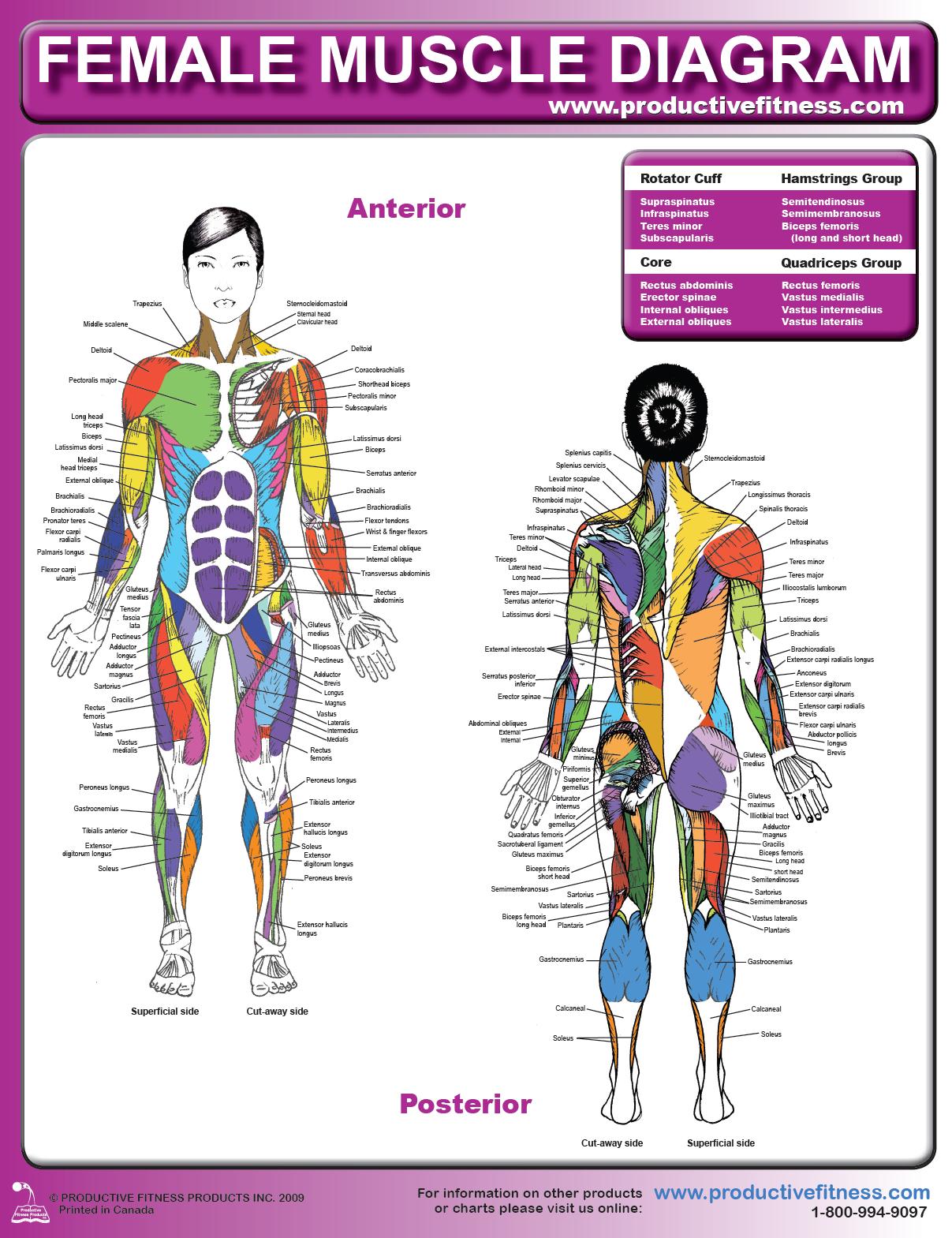
Female Muscle Diagram and Definitions

Female muscle diagram

Female muscle diagram

DEFINITIONS

Abductor muscle (ab-duhk-ter)  A muscle which draws a limb away from the median plane of the body.

Abs or abdominals (ab-dom-uh-nl)  The abdominal muscles are a group of 6 muscles that extend from various places on the ribs to various places on the pelvis. They provide movement and support to the trunk, often called the core. They also assist in the breathing process.

Adductor muscle (uh-duhk-ter)  A muscle which brings a part of the anatomy closer to the median plane of the body.

Aerobic (ai-roh-bik)  Requiring the presence of air or oxygen.

Bis or biceps (bahy-seps)  A flexor muscle located in the front of the upper arm and assisting in bending the arm.

Core (kohr) – see abdominals – The six abdominal muscles are: transverse abdominal, two internal obliques, two external obliques and the rectus abdominis.

Cuffs or Rotators Cuffs (roh-ta-tor)  A  bandlike structure encircling and supporting the shoulder joint, formed by four muscles attached and merging with the joint capsule.

Glutes or gluteous maximus (gloo-te-us mak-suh-muhs)  The broad, thick, outermost muscle of the buttocks, involved in the rotation and extension of the thigh.  The largest muscle in the body.

Hams or hamstrings (ham-strings)  Refers to one of the three posterior thigh muscles, or to the tendons that make up the borders of the space behind the knee.

Karvonen Method – The method of taking heartrates that factors in the resting heart rate to calculate a target heart rate using a range of 50-85%.

Lats or latissimus dorsi (luh-tis-uh-muhs dawr-sahy)   A broad, flat muscle on each side of the midback, the action of which draws the arm backwards and downward and rotates the front of the arm toward the body.

Muscle (muhs-uhl) – A tissue composed of cells or fibers, the contraction of which produces movement in the body

Obliques (oh-bleek)  The external oblique muscles of the abdomen functions to pull the chest downwards and compress the abdominal cavity.  When the internal oblique contracts it compresses the organs of the abdomen, pushing them up into the diaphragm.  Its contraction also rotates and side-bends the trunk by pulling the rib cage and midline towards the hip and lower back.

Pecs or pectorals (pek-ter-uhl)  A thick, fan-shaped muscle, situated at the chest (anterior) of the body. It makes up the bulk of the chest muscles in the male and lies under the breast in the female.

Quads or quadriceps (kwod-ruh-seps)  A large muscle group that includes the four prevailing muscles in the front of the thigh, the action of which extends the leg or bends the hip joint.

Traps or trapezius (truh-pee-zee-uhs)  A broad, flat muscle on each side of the upper and back part of the neck, shoulders and back, the action of which raises, or rotates, or draws back the shoulders, and pulls the head backwards or to one side.

Tris or triceps (trahy-seps)  A muscle having three heads or points of origin, especially the muscle on the back of the arm, the action of which straightens the elbow.

Vertifirm™ (ver-ti-firm) – “vertical firmness” –  Standing up floor exercises allowing you the benefit of working more than one muscle group at a time by adding upper body resistance training.