

Category Archives: muscle and fitness
Osteoporosis — Is Weight Training the solution?
Every 5 minutes, someone is admitted to hospital with an osteoporotic fracture.
Is weight training the solution?
With two-thirds of women and one-third of men over 60 suffering an osteoporotic fracture, the race is on to find a way to reverse bone damage. Beverley Hadgraft investigates:
Whenever associate professor Belinda Beck hears of another school that’s banned kids from doing cartwheels or playing on the monkey bars, she despairs. Why? Because for every child who suffers an injury from such activities, 10,000 more will benefit in terms of reducing their future risk of osteoporosis just my doing weight-bearing and osteogenic exercises (specific to bone development – such as twisting, turning and jumping) at an age when it really matters, she says.
Beck, who’s a professor at the Centre for Musculoskeletal Research at the Griffith Health Institute in Queensland, says most of our lifelong bone mass is built before the age of 20. “You can increase your bone bank to such an extent during that period that when you start losing bone – as everyone does – your bone mass never falls below the fracture threshold,” she explains. This means you’re less likely to develop osteoporosis, the disease in which bones weaken and are more prone to fracture.
While this is good advice for our kids, what does it mean for the current osteoporosis epidemic in adults? Every five to six minutes, someone is admitted to an Australian hospital with an osteoporotic fracture, and this is set to rise to every three to four minutes by 2021.
The Potential Benefits
So can bone density be increased later in life? “That’s the million-dollar question that we need more research on,” Beck says. For this reason, she and her team have recruited 100 post-menopausal women with low bone mass for an exercise study, with the aim of finding out if it’s possible to increase bone density through serious weight training.
In the past, heavy weight training has been discouraged for those with osteoporosis because lifting heavy weights incorrectly can crush the vertebrae (and anyone with low bone density shouldn’t embark on a weightlifting program unless it’s properly supervised and they’ve spoken to their GP or specialist). However, Beck became interested in the idea of using such training as a treatment after hearing of a Queensland woman with osteoporosis whose bone density had improved through lifting weights.
Seven years ago, Gold Coast Olympic weightlifter Lisa Weis was approached by the woman, who’d read that lifting weights might improve her condition. Weis, who has a degree in human movement, agreed to teach her the correct technique, and showed her how to keep her back straight and core engaged, and use compound movements such as squats, deadlifts, push-ups and chin-ups.
After subsequent scans revealed that the woman’s bone density had improved, Weis chose to become a specialist in helping osteoporotic women improve their condition. “I now have women in their 60’s who can effortlessly deadlift 60kg or 70kg and do chin-ups,” Weis says. “And a 74-year-old who can deadlift her bodyweight.”
That’s a good outcome in itself, she says, as it improves mobility and therefore the chances of independent living in older age. However, equally impressive have been her clients’ scans which, she says, have shown a halt in bone decline and even increases in bone density – one woman saw an increase of 5.8 per cent – without medication.
Protecting Your Bones
Given the unpleasant side-effects of the current medication used to treat osteoporosis, Beck says that finding a non-pharmacological treatment would benefit thousands of Australians. When Weis first approached Beck with her findings, the researcher admits she wasn’t sure what to make of the results, but says now that Weis is “using very correct technique so it’s possible that she’s using a strategy that’s safe and effective”.
The Griffith study will see one group of women do a supervised resistance training program, while the other will do a home-based controlled exercise program, twice a week for eight months. Calcium intake will be monitored, and the participants will then be tested for improvement in bone strength, body composition and physical function.
In the meantime, Beck says we should all be actively working to reduce our osteoporosis risk. Weight-bearing exercise such as brisk walking, jogging, skipping and dancing, and resistance training such as lifting hand weights or ankle weights, have been found to improve bone density. Her earlier research has also shown that regular stomping can help to maintain bone density, and she says a way to incorporate this into daily life is to stomp every morning while you clean your teeth.
Other proven ways to reduce your risk include eating a healthy diet with three to five serves of calcium-rich food (at least 1000mg) a day – such as dairy products, legumes and oily fish – and getting enough vitamin D from safe sun exposure.
IF YOU HAVE OSTEOPOROSIS
It’s important to consult your doctor or physiotherapist about any exercise regime. Don’t attempt heavy lifting, jumping, twisting or jarring without medical advice.
Hip Lifts, Press Forearms/Delts/Angles

Sidelifts Low, Cuffs Out

The best time to stretch
Stretching offers many benefits: mobility, injury prevention and stress relief, to name a few. But when exercising, is it better to stretch before or after? The answer is: before and after.
Before exercise you need to warm up and dynamic stretching can be combined as part of the warm-up. The goal is to get the blood flowing and raise your body temperature a little. It’s important to have your muscles, ligaments and joints experience the functional range of motion required of your sport during the warm-up. Movements such as arm circles, torso twists and hip rotations are examples of dynamic stretches.
After your workout, it’s time for static stretching. This is the time to relax, wind down and improve flexibility. Hold each stretch for at least 30 seconds and stretch consistently to see results. Focus on breathing during the stretch, using each exhalation to go a little further.
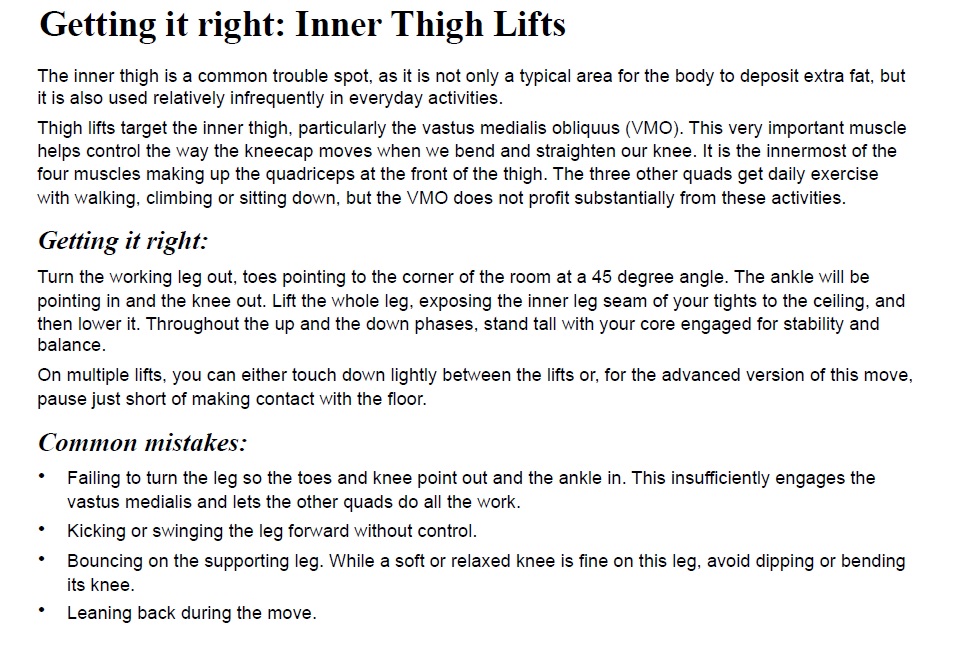
Inner Thigh Lifts
Female Muscle Diagram and Definitions
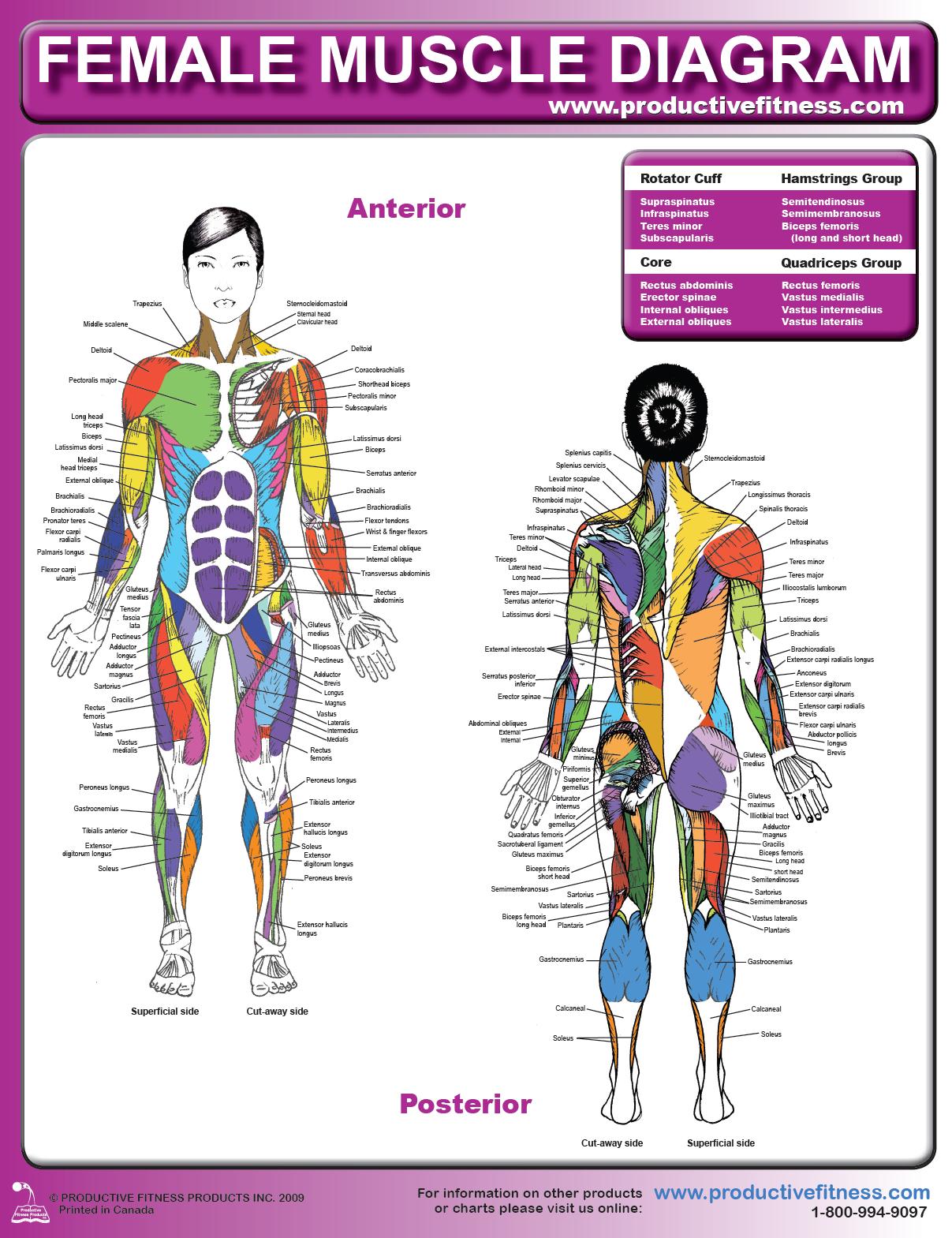
Female muscle diagram
DEFINITIONS
Abductor muscle (ab-duhk-ter) A muscle which draws a limb away from the median plane of the body.
Abs or abdominals (ab-dom-uh-nl) The abdominal muscles are a group of 6 muscles that extend from various places on the ribs to various places on the pelvis. They provide movement and support to the trunk, often called the core. They also assist in the breathing process.
Adductor muscle (uh-duhk-ter) A muscle which brings a part of the anatomy closer to the median plane of the body.
Aerobic (ai-roh-bik) Requiring the presence of air or oxygen.
Bis or biceps (bahy-seps) A flexor muscle located in the front of the upper arm and assisting in bending the arm.
Core (kohr) – see abdominals – The six abdominal muscles are: transverse abdominal, two internal obliques, two external obliques and the rectus abdominis.
Cuffs or Rotators Cuffs (roh-ta-tor) A bandlike structure encircling and supporting the shoulder joint, formed by four muscles attached and merging with the joint capsule.
Glutes or gluteous maximus (gloo-te-us mak-suh-muhs) The broad, thick, outermost muscle of the buttocks, involved in the rotation and extension of the thigh. The largest muscle in the body.
Hams or hamstrings (ham-strings) Refers to one of the three posterior thigh muscles, or to the tendons that make up the borders of the space behind the knee.
Karvonen Method – The method of taking heartrates that factors in the resting heart rate to calculate a target heart rate using a range of 50-85%.
Lats or latissimus dorsi (luh-tis-uh-muhs dawr-sahy) A broad, flat muscle on each side of the midback, the action of which draws the arm backwards and downward and rotates the front of the arm toward the body.
Muscle (muhs-uhl) – A tissue composed of cells or fibers, the contraction of which produces movement in the body
Obliques (oh-bleek) The external oblique muscles of the abdomen functions to pull the chest downwards and compress the abdominal cavity. When the internal oblique contracts it compresses the organs of the abdomen, pushing them up into the diaphragm. Its contraction also rotates and side-bends the trunk by pulling the rib cage and midline towards the hip and lower back.
Pecs or pectorals (pek-ter-uhl) A thick, fan-shaped muscle, situated at the chest (anterior) of the body. It makes up the bulk of the chest muscles in the male and lies under the breast in the female.
Quads or quadriceps (kwod-ruh-seps) A large muscle group that includes the four prevailing muscles in the front of the thigh, the action of which extends the leg or bends the hip joint.
Traps or trapezius (truh-pee-zee-uhs) A broad, flat muscle on each side of the upper and back part of the neck, shoulders and back, the action of which raises, or rotates, or draws back the shoulders, and pulls the head backwards or to one side.
Tris or triceps (trahy-seps) A muscle having three heads or points of origin, especially the muscle on the back of the arm, the action of which straightens the elbow.
Vertifirm™ (ver-ti-firm) – “vertical firmness” – Standing up floor exercises allowing you the benefit of working more than one muscle group at a time by adding upper body resistance training.
Building Strength for Women in particular:
Walk into any gym and you’ll probably see the weights room filled with men doing bench presses, while the stretch classes are 99% female. This needs to be reversed, say Greg Stark, from Better Being Personal Training.
How aerobic dancing benefits your fitness now!
Fitness isn’t instantaneous, but you need to make a start. The biggest problem is finding something you can commit to with the discipline that gets results. Congratulations! You’ve already done that. By joining Jacki’s Aerobic Dancing, you’ve found, like thousands of others, that coming to class is a joy because Jacki’s program is FUN. That’s why some of you have been coming continuously since classes opened in Sydney in 1981. Continue reading How aerobic dancing benefits your fitness now!